
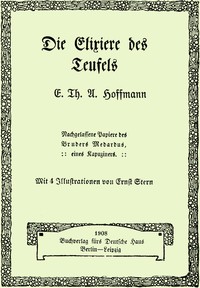
Die Elixiere des Teufels : Nachgelassene Papiere des Bruders Medardus, eines…
Let's talk about a book that starts in a monastery and ends up... well, everywhere else. E.T.A. Hoffmann's The Devil's Elixirs is the fictional confession of Brother Medardus, a Capuchin monk with a respectable preaching career and a simmering inner turmoil.
The Story
The monastery houses a relic: a bottle of the Devil's own elixir. Medardus, tempted, takes a drink. This single act unlocks a Pandora's box. He's suddenly consumed by worldly passions and flees into the outside world he once renounced. His journey becomes a nightmare of mistaken identity. He keeps encountering a mysterious double—a man who looks just like him, the painter Franz—who shadows his steps, seemingly framing him for terrible acts. Medardus falls in love, gets entangled in aristocratic schemes, and is haunted by visions of a sinful ancestor whose curse might be playing out through him. The plot is a dizzying chase where Medardus can't tell if he's the hunter, the victim, or the villain in his own story.
Why You Should Read It
What grabbed me wasn't just the spooky doppelgänger stuff (though that's great). It's how Hoffmann gets inside Medardus's head. We feel his panic and confusion as his sense of self shatters. Is he possessed? Insane? Or just a man finally confronting the dark desires he bottled up for years? The book is a messy, thrilling look at the battle between who we are and who we're supposed to be. Hoffmann also has this sly, almost sarcastic tone that cuts through the Gothic gloom. He doesn't just want to scare you; he wants to make you think about fate, guilt, and how thin the line is between a saint and a sinner.
Final Verdict
This book is perfect for readers who find classic horror a bit stuffy and want something with psychological bite. If you enjoyed the identity puzzles in stories like Dr. Jekyll and Mr. Hyde or the paranoid, spiraling plots of Kafka, you'll find a fascinating ancestor here. It's for anyone who loves a story where reality is constantly in question and the hero might be his own worst enemy. Fair warning: it's a complex, layered novel from 1815, so it demands your attention. But if you give it, you'll be rewarded with one of the weirdest, most inventive, and strangely relatable nightmares in all of literature.
This content is free to share and distribute. You do not need permission to reproduce this work.
Susan Allen
8 months agoAs someone who reads a lot, the author's voice is distinct and makes complex topics easy to digest. Highly recommended.
Thomas White
1 year agoWithout a doubt, the plot twists are genuinely surprising. One of the best books I've read this year.



Ethan Garcia
1 year agoThe formatting on this digital edition is flawless.