1

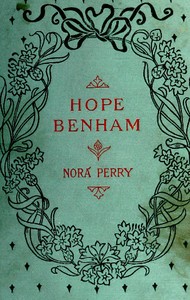
Hope Benham: A Story for Girls — Reading Notes
25
5
Project Gutenberg
2011
Poor -- Juvenile fiction; Conduct of life -- Juvenile fiction; Girls -- Conduct of life -- Juvenile fiction; Students -- Juvenile fiction; Diligence -- Juvenile fiction; Success -- Juvenile fiction; Violinists -- Juvenile fiction; Musicians -- Juvenile fiction
Readers of public-domain and historical texts
Project Gutenberg digital edition
en
Edition facts
Words: 69,038
Reading time: 301 min
Text sections: 7
Source:
Project Gutenberg record #36105
Nora Perry's 1894 novel follows Hope Benham, a young violinist from Riverview, as she navigates class distinctions and artistic ambition. The opening scene contrasts Brookside's affluent station with Riverview's industrial character, while dialogue reveals Hope's reserve and her prized Cremona violin.
Editorial Edition Score
4.7/5
★★★★★
★★★★★
Calculated from edition completeness, EPUB availability, text structure and catalogue metadata. Not a user rating.
Edition quality
The novel opens not with Hope Benham herself, but with a cry—"Ten cents a bunch! ten cents a bunch!"—that draws three Brookside girls to a flower seller. That seller is Hope, and the transaction immediately establishes a central tension: the girls' casual delight in the arbutus contrasts with Hope's labor in picking and selling it. Perry sharpens this contrast by juxtaposing the two stations: Brookside, with its "fine and elegant stone structure," and Riverview, "just a plain little wooden building." The arbutus, found in Riverview woods, becomes a token of the natural world that bridges—but does not erase—the economic divide between the towns.
Dialogue as a Tool of Character
Perry uses dialogue to reveal character with economy. When Dolly Dering presses Hope to participate in a musicale, Hope's replies are brief and evasive: "I don't think I can." Dolly's persistence—"whipping out that tablet with a 'Now, then, give an account of yourself' air"—prompts her brother Jimmy to call her "the biggest bully I ever met." The quarrel that follows exposes Dolly's tearful defensiveness and Jimmy's bluntness, while Mrs. Dering's hushed admonition—"Children, children, stop quarrelling, right here in public!"—underscores the social proprieties that govern their world. Hope's own voice remains largely unheard in this exchange, her reticence a counterpoint to the Dering family's voluble self-assertion.
The Violin as a Marker of Identity
Hope's violin is not merely a prop but a carefully specified object. Dolly reports that it "cost enough" and is "a regular Cremona," made by "an Italian who was a pupil of Stradivari." Jimmy's excited response—"to see a real old Cremona would be worth while"—and his digression about imitations signal the violin's cultural weight. The instrument's provenance, traced through an old teacher and a brother in Paris, links Hope to a lineage of craftsmanship and artistry that transcends her modest circumstances. Perry does not describe the violin's appearance; instead, she lets its reputation and the characters' reactions define its significance.
Setting as Social Commentary
The opening chapter draws a sharp geographical and social line: "In Riverview were manufactories, locomotives, and iron-works... But in Brookside were only fine suburban residences." The railroad station of each town mirrors its inhabitants—Brookside's "fine and elegant stone structure" versus Riverview's "plain little wooden building." This binary is not merely backdrop; it shapes the characters' interactions. The Brookside girls' surprise that arbutus grows "so near Boston as that" betrays their limited awareness of the neighboring town. Perry uses setting to dramatize class distance without explicit editorializing, letting the physical details speak for themselves.
Reticence and Revelation in Narrative Voice
Perry's narrator often withholds direct access to Hope's interiority, especially in early scenes. When Dolly interrogates her, the narrative reports only Hope's spoken words and a few gestures—"glancing up from her contemplation of the flowers to the flower-seller." The reader must infer Hope's feelings from her brevity and from others' reactions. Later, when Mrs. Dering recalls meeting Hope's father in Paris, the information arrives secondhand, filtered through memory and speculation. This indirect method builds curiosity about Hope's inner life while aligning the reader with the limited perspective of the Dering family. The effect is to make Hope's eventual emergence as a musician and individual all the more striking.
Readers attentive to Perry's craft will notice how she weaves economic detail, musical lore, and social friction into a narrative that resists easy sentiment. The arbutus, the Cremona, the stations—each carries weight beyond its immediate function. Hope herself remains partly opaque, a figure whose reserve invites interpretation. This edition preserves the original illustrations by Frank T. Merrill, which capture key moments—Hope with her violin, the flower-selling scene—that complement Perry's verbal textures.
Reader reflection
How will you remember this book?
Save your reaction, strongest insight, and memorable passage.
Your progress
0
/
10
2
Did this book hold your interest?
3
How likely are you to recommend this book?
4
What was the reading difficulty like?
5
Did any part of the book stay with you emotionally?
6
What was the strongest part of the book?
7
How clearly were the main ideas presented?
8
How closely did the book connect with your experience?
9
What changed or sharpened your thinking?
10