
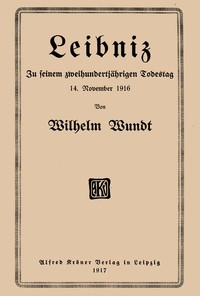
Leibniz: Zu seinem zweihunderjährigen Todestag 14. November 1916 by Wundt
Published in the grim year of 1916, this book is a centennial tribute with a heavy heart. Wilhelm Wundt, a major figure in the new science of psychology, turns his attention to one of history's last great polymaths, Gottfried Wilhelm Leibniz. The book is structured as a series of connected essays, walking us through Leibniz's colossal contributions.
The Story
There's no traditional plot, but there is a clear journey. Wundt maps out the landscape of Leibniz's mind. He starts with the big, famous ideas—like the Monadology (his theory that reality is made of spiritual units called monads) and the optimistic idea that we live in the 'best of all possible worlds.' But Wundt doesn't stop at the philosophy we all vaguely remember. He pushes into Leibniz's groundbreaking work in mathematics (he invented calculus independently of Newton!), his visions for a universal language, and his diplomatic efforts. Wundt paints a portrait of a man who believed deeply in the power of reason to connect everything—science, faith, politics—into a harmonious whole.
Why You Should Read It
Here's what got me: the haunting subtext. Reading this in the 21st century, you can't ignore when it was written. Wundt is celebrating German intellectual heritage from inside a maelstrom of war. His prose is measured and academic, a deliberate act of preservation. It feels like he's building a mental fortress of ideas against the madness outside. This gives his analysis a unique weight. You're not just learning about Leibniz; you're witnessing how a later great mind, under immense pressure, chooses to remember and honor a predecessor. It’s history looking at history, with a layer of unspoken tragedy in between.
Final Verdict
This isn't a casual weekend read. It's for a specific reader: the history of science or philosophy enthusiast who loves context as much as content. It's perfect for anyone interested in how ideas travel through time, or in the quiet ways scholars respond to world-shattering events. If you want a dynamic, modern biography of Leibniz, look elsewhere. But if you want to hold a piece of intellectual history from one of Europe's darkest hours—a thoughtful, slightly solemn tribute to reason from the edge of the abyss—then this century-old volume offers a uniquely powerful and reflective experience.
This title is part of the public domain archive. You do not need permission to reproduce this work.
Mark Moore
1 year agoSolid story.
Mason Nguyen
1 year agoFrom the very first page, the author's voice is distinct and makes complex topics easy to digest. A valuable addition to my collection.
Logan Wright
1 year agoI came across this while browsing and the clarity of the writing makes this accessible. A true masterpiece.
George Rodriguez
7 months agoThis book was worth my time since it challenges the reader's perspective in an intellectual way. I will read more from this author.

Sandra King
2 months agoI stumbled upon this title and the flow of the text seems very fluid. A valuable addition to my collection.