
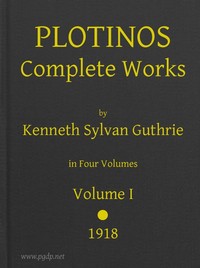
Plotinos: Complete Works, v. 1 by Plotinus
Let's be clear from the start: you don't 'read' Plotinus like a novel. You don't follow a plot from A to B. Instead, think of this book as a series of deep, meandering conversations with a genius philosopher from the 3rd century. He's trying to map the entire structure of reality, from the highest, most perfect principle—which he calls 'The One'—all the way down to the physical world we live in. In between are layers of reality like the Divine Mind and the World Soul.
The Story
There's no protagonist or villain. The 'story' is the journey of the human soul. Plotinus lays out his vision of a universe that flows from a single, supreme source of all goodness and being. Our world, with all its suffering and imperfection, is the farthest ripple from that source. The core narrative is our soul's struggle: we've become distracted and trapped by the physical world (bodies, desires, material things), but our true home is back with that divine source. The entire work is a guide for how to undertake the journey back—through philosophy, virtue, and a special kind of intuitive knowledge he calls 'contemplation.'
Why You Should Read It
I picked this up out of historical curiosity, but I was stunned by how personally relevant it felt. In a world that constantly tells us to seek happiness externally, Plotinus insists it's an inside job. His idea that beauty, truth, and goodness are real things we can connect with, not just abstract concepts, is incredibly comforting. It's challenging—he uses logic to argue that ultimate reality is beyond logic—but that's the point. He's trying to put into words something that words can't fully capture. Reading him makes you stop and re-examine your own life. It asks the biggest questions: What am I? What is real? Where do I belong?
Final Verdict
This is not a casual beach read. It's for the curious thinker, the spiritual seeker who isn't satisfied with simple answers, or the reader who loves history and wants to get inside the mind that shaped centuries of Christian, Islamic, and Western mystical thought. It's perfect if you've ever enjoyed writers like Marcus Aurelius or Rumi and want to explore the deep philosophical roots of those ideas. Be prepared to read slowly, to re-read paragraphs, and to have your perspective quietly but permanently shifted.
This text is dedicated to the public domain. It serves as a testament to our shared literary heritage.
Edward Davis
1 year agoThanks for the recommendation.
Noah King
1 year agoI didn't expect much, but the author's voice is distinct and makes complex topics easy to digest. Definitely a 5-star read.
Michelle White
5 months agoRead this on my tablet, looks great.
Anthony Hernandez
3 months agoI was skeptical at first, but the character development leaves a lasting impact. Absolutely essential reading.









Nancy Perez
9 months agoCompatible with my e-reader, thanks.