1

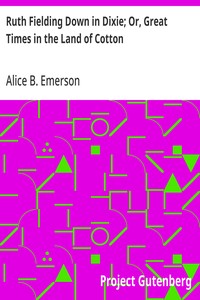
Ruth Fielding Down in Dixie; Or, Great Times in the Land of Cotton — Themes and Context
26
7
Project Gutenberg
2011
Voyages and travels -- Juvenile fiction; Girls -- Juvenile fiction; Thieves -- Juvenile fiction; Fielding, Ruth (Fictitious character) -- Juvenile fiction; Theft -- Juvenile fiction; Chesapeake Bay (Md. and Va.) -- Juvenile fiction
Readers of public-domain and historical texts
Project Gutenberg digital edition
en
Edition facts
Words: 49,272
Reading time: 215 min
Text sections: 6
Source:
Project Gutenberg record #36747
In this tenth Ruth Fielding volume, the plucky heroine travels from New York to a Chesapeake Bay cotton plantation, encountering a runaway boy and a theft mystery. The catalog subjects emphasize theft and travel, but the excerpts focus more on Ruth's social observations and her efforts to help the boy Curly Smith.
Editorial Edition Score
4.7/5
★★★★★
★★★★★
Calculated from edition completeness, EPUB availability, text structure and catalogue metadata. Not a user rating.
Edition quality
The opening chapter of Ruth Fielding Down in Dixie introduces the heroine and her chum Helen Cameron not through action but through sharp, unflattering commentary on a stranger. Ruth and Helen mock a girl's appearance—her "white-stitched shoes" and skirt that "hangs"—before speculating whether she is a fellow passenger. This initial focus on social judgment, rather than plot, sets a tone of class and appearance consciousness that recurs throughout the excerpts.
Judging by Appearances
The excerpts show Ruth and Helen repeatedly assessing people by their looks and behavior. At the dock, they laugh at an "odd acting girl" and dismiss her as "gawky." Later, Ruth reflects on Curly Smith, a boy they encounter at a cotton warehouse, describing him as "ragged and hungry" and speculating about his motives. The narrative voice aligns with Ruth's perspective, presenting her judgments as reasonable. Yet the catalog subjects list "thieves" and "theft," while the excerpts reveal that Ruth's primary concern is not crime but social propriety and her own charitable impulses. The theft subplot remains in the background, mentioned only as a rumor about Curly.
Ruth as Moral Arbiter
Ruth takes on the role of a moral guide, particularly toward Curly Smith. She writes to his grandmother, hoping to reconcile them, and muses that his hardships might teach him "that his home is better than a loose life among strangers." She also decides not to reveal his presence to authorities, reasoning that "his crime is not so great in the eyes of the law." This paternalistic attitude aligns with the series' pattern of Ruth solving problems through letter-writing and persuasion rather than direct confrontation. The excerpts do not show any theft or pursuit; instead, they depict Ruth managing a wayward boy's fate from a distance.
Setting as Backdrop, Not Driver
Despite the title's promise of "Great Times in the Land of Cotton," the excerpts use the Southern setting sparingly. The Merredith plantation appears as a location for rest and letter-writing, not for cotton-related activity. The only specific detail is the "warm, moist climate" that necessitates a siesta. The catalog subject "Chesapeake Bay" is mentioned only in passing as a place where Ruth and Helen saw a deer. The setting functions as a stage for Ruth's social interactions rather than as an integral element of the plot. This gap between catalog subjects and textual emphasis suggests that the book's travel and regional elements are secondary to character-driven moral lessons.
Readers approaching Ruth Fielding Down in Dixie should expect a story driven by Ruth's observations and interventions rather than by adventure or crime. The excerpts reveal a heroine who is more concerned with reforming a runaway boy than with solving a theft. The Southern setting, while advertised, remains a backdrop for Ruth's moralizing. Those interested in the series' characteristic blend of friendship and problem-solving will find familiar ground here, but those seeking a fast-paced mystery may need to adjust expectations.
Reader reflection
Your personal reading reflection
Build a private reading journal entry for this title.
Your progress
0
/
10
2
Did this book hold your interest?
3
How likely are you to recommend this book?
4
How much effort did this book require?
5
How useful did the reading feel?
6
Is this a title worth rereading?
7
How original did the book feel?
8
Did the story or argument move comfortably?
9
Which lesson or insight stayed with you?
10