1

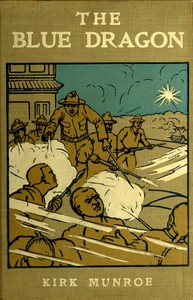
The Blue Dragon: A Tale of Recent Adventure in China — Themes and Context
32
13
Project Gutenberg
2013
Conduct of life -- Juvenile fiction; Adventure stories; Friendship -- Juvenile fiction; Voyages and travels -- Juvenile fiction; Youth -- Conduct of life -- Juvenile fiction; Prejudices -- Juvenile fiction; China -- History -- Boxer Rebellion, 1899-1901 -- Juvenile fiction; China -- Description and travel -- Juvenile fiction; Chinese Americans -- Juvenile fiction
Readers of public-domain and historical texts
Project Gutenberg digital edition
en
Edition facts
Words: 68,649
Reading time: 299 min
Text sections: 6
Source:
Project Gutenberg record #42886
Kirk Munroe's 1905 adventure novel follows young American Rob Hinckley into Boxer Rebellion-era China. The catalog subjects emphasize conduct-of-life themes, but the excerpts foreground a chase, a mysterious Chinese officer, and the author's own framing of the Blue Dragon as China's national emblem. The story blends historical context with perilous escape.
Editorial Edition Score
4.7/5
★★★★★
★★★★★
Calculated from edition completeness, EPUB availability, text structure and catalogue metadata. Not a user rating.
Edition quality
Kirk Munroe opens The Blue Dragon not with his young hero but with an author's note explaining the title: the dragon is China's national emblem, chosen to flatter a powerful evil spirit. This framing signals that the novel will treat Chinese beliefs as exotic curiosities rather than lived realities. The excerpts then drop readers into a chase: Rob Hinckley, an American alone in north China during the Boxer Rebellion, flees a mob that cries “Death to the foreign devil!” The scene is built on speed and confusion—Rob does not understand the local dialect and knows “almost nothing of the Boxer movement.” A mysterious Chinese officer in imperial uniform shouts English advice from a watch-tower. The catalog lists “Conduct of life” and “Friendship” as subjects, but the excerpts emphasize survival, miscommunication, and a sudden alliance across cultural lines.
A National Emblem and Its Story
Munroe’s preface explains that the Blue Dragon was adopted as China’s emblem to “flatter and propitiate that spirit of evil considered to be the most powerful.” He draws a parallel to the American eagle, calling both “strongest of visible air spirits.” This comparison reveals the author’s didactic intent: he wants to make Chinese cosmology legible to young American readers by framing it as analogous to their own symbols. The catalog subject “Conduct of life” appears here in the moral lesson that nations choose emblems based on what they fear or admire. Yet the excerpts do not show the dragon appearing in the plot; it remains a conceptual anchor. The preface also sketches recent Chinese history—the Empress Dowager’s coup, the repeal of reforms, the spread of the Boxer movement—presenting the rebellion as a backdrop of “hatred of foreigners” rather than a complex political event.
The Chase and the Voice from the Gate
The opening chapter excerpt, “A Stranger in a Strange Land,” plunges Rob into a chase without context. He is “deserted and alone in the presence of a mob of crazed fanatics.” The prose is breathless: Rob spurs his pony, the mob yells, and he realizes he might be “jumping from the frying-pan into the fire” if he enters the city. The turning point is a voice in English shouting, “Keep on to the gate! It's your only chance!” The speaker is a young Chinese officer who had been watching from a loop-hole, initially assuming Rob was a native traveler. This moment of unexpected aid contradicts the catalog’s subject “Prejudices”—the officer acts not out of prejudice but out of recognition of a fellow human in danger. The excerpts do not reveal the officer’s name or motives, leaving the reader to wonder how this alliance will develop.
History as Adventure Backdrop
Munroe interrupts the narrative to summarize the Boxer Rebellion’s origins: the Empress Dowager “assumed the reins of power,” reform decrees were repealed, and “hatred of foreigners was preached more loudly and more bitterly than ever.” He describes mission stations looted, Christian converts massacred, and railroad property destroyed. This historical summary is placed before Rob’s flight, suggesting that Munroe intends the adventure to illustrate a real crisis. The catalog subject “China -- History -- Boxer Rebellion, 1899-1901” is thus directly addressed, but the excerpts treat the rebellion as a monolithic wave of violence rather than a complex uprising. Rob’s ignorance of the dialect and the movement underscores his vulnerability; the story’s tension comes from his lack of information. The author’s note and the chase together position the novel as a blend of historical education and survival adventure, with the Blue Dragon emblem serving as a cultural lesson.
Readers approaching The Blue Dragon should note that the excerpts cover only the opening chase and the author’s preface; the full novel likely follows Rob and the Chinese officer through the siege of Peking and beyond. The catalog subjects promise themes of friendship and conduct, but the excerpts emphasize action and historical exposition. Pay attention to how Munroe balances his educational asides—about Chinese beliefs, the Boxer movement, and the dragon emblem—with the forward momentum of the plot. The officer’s unexplained English and his decision to help a foreigner may be the story’s emotional core.
Reader reflection
What did you think of this book?
Answer a few questions and save a private reflection on this device.
Your progress
0
/
10
2
How much did you enjoy the reading experience?
3
Is this a title you would suggest to others?
4
How much effort did this book require?
5
How personally connected did you feel to the book?
6
How well did it match your expectations?
7
Would a second reading be valuable?
8
Did any part of the book stay with you emotionally?
9
What is the main idea you are taking away?
10